 1inch
1inch routes token swaps through aggregated liquidity
1inch connects wallet-based token swaps to liquidity from multiple decentralized exchanges (DEXes). Its Aggregation Protocol routes trades across those sources, while Fusion lets market makers called resolvers compete to execute trades under the user's terms. Fusion+ extends this model across supported networks. The wider ecosystem also includes limit orders, liquidity provision, a self-custodial wallet, and developer APIs.
Decentralized finance (DeFi) uses blockchain-based applications for financial services, including exchanges that operate through smart contracts. The wallet holder signs transactions or orders to authorize interactions with those contracts. The selected route, approval method, and network determine how a swap starts, who pays execution costs, and what happens to an unfinished trade.
Token permission comes before swap execution
A wallet-based swap depends on a compatible network, sufficient assets, and the spending permission required by its particular execution path. For signed orders, the account offering the input tokens is the maker, while the participant filling the order is the taker.
ERC-20 approval and signed permits
On Ethereum Virtual Machine (EVM) networks, ERC-20 tokens commonly use allowances that authorize a specific contract to spend an approved amount. The allowance belongs to the selected token, spender, and network, so another asset or contract can require separate permission. An approval changes that permission without exchanging the tokens. If the required approval needs an on-chain transaction, the wallet must fund its network fee before swap execution. A signed permit avoids a separate approval transaction only where the token and chosen spending mechanism support it.
| EVM-source ERC-20 swap path | Swap authorization | Funds when execution remains incomplete |
|---|---|---|
| Aggregation / Market | The wallet signs a transaction and pays its network fee. | A reverted swap undoes its token exchanges. |
| Fusion | The maker signs an off-chain order; a resolver pays fill gas. | An unfilled order expires without transferring its input tokens. |
| Fusion+ | The maker signs an order; resolvers fund cross-chain settlement. | Source escrow cancellation returns the maker's locked tokens under its timelock rules. |
Submission and completed transfers
A signature authorizes the requested terms, and a pending transaction or order reports an intermediate state. Successful settlement records the token transfers associated with the swap. For an order that permits partial fills, its filled amount can be smaller than the original request. The execution record distinguishes the completed portion from any unfilled amount; an approval receipt confirms spending permission.
What determines the amount received from aggregated liquidity?
The Aggregation Protocol's quoted output depends on the asset pair, amount, available liquidity, and costs along the route.
Pathfinder and liquidity depth
Pathfinder is the routing algorithm that evaluates integrated sources, including potential intermediate tokens and different market depths within a protocol. It can split a swap among routes, spreading the trade across the available liquidity. The Aggregation Protocol executes the resulting route on-chain. Additional routing complexity consumes gas, which can offset a larger token quote when comparing the overall cost of execution. A different input amount can change the preferred route because each source has its own liquidity depth. Thin liquidity can still produce substantial price impact even when several routes are available.
Price impact and slippage
Price impact is the change that the trade itself causes in execution prices, especially in a shallow liquidity pool. Slippage describes the difference between the quote and eventual execution as market conditions change. For wallet-submitted aggregation swaps, the minimum-return condition sets the least output that the transaction may accept. A swap that fails this condition reverts. Increasing slippage tolerance widens that boundary without adding liquidity or changing the identity of a selected token.
Costs reflected in the trade
Network fees pay for on-chain computation, while the fee that a liquidity pool charges affects the exchange economics. Resolver costs enter the quoted trade terms even when the wallet pays no gas for fulfillment. Protocol or integration fees can also apply, depending on the route and interface. Received tokens and separately paid network fees therefore represent different parts of the trade's overall cost.
Fusion and limit orders set different execution conditions
Fusion uses auction-based execution, while conventional limit orders let the maker choose a target exchange rate and validity period. For EVM orders funded with ERC-20 tokens, the maker signs an off-chain order. Native-token Fusion swaps require a user-funded escrow transaction that wraps and locks the input before resolver execution. A resolver pays the gas for filling an EVM Fusion order. A Dutch auction gradually lowers the offered exchange rate over its execution window. The EVM Fusion flow provides front-running protection through resolver settlement. An order can expire if no resolver fills it, while permitted partial fills allow smaller executions to contribute toward the requested amount.
Limit orders use signed trade conditions, including a chosen rate and validity period, with funds remaining in the maker's wallet until execution. A displayed chart price can reach the target while an order remains unfilled, because on-chain prices or taker economics differ. The wallet must still have sufficient balances and permissions for the amount that the taker fills. The Limit Order Protocol also accommodates request for quote (RFQ) trading through its order structure.
Solana Fusion follows a different setup. The user signs and funds an on-chain escrow transaction, and resolvers can subsequently fill the order. The maker can cancel an unfilled order to recover its escrowed input tokens. EVM signing and fee assumptions therefore do not describe every implementation.
Fusion+ coordinates token exchanges across networks
Fusion+ is the cross-chain extension of intent-based swaps, available for supported source and destination networks. For an EVM-source swap, source escrow holds the maker's input tokens and destination escrow holds the resolver's output tokens. Corresponding escrows use matching hashlocks, which require the appropriate secret for withdrawal. Timelocks define when withdrawals and cancellations become available, including recovery that returns eligible escrowed funds to their original owners. Funding source escrow is an intermediate state; it does not establish that the destination tokens have arrived.
The browser-based Fusion+ interface requires the swap tab to remain open for secret sharing. Closing it can interrupt secret sharing and result in cancellation. For Solana-source swaps, the order is announced to the relayer and published through a source-chain escrow transaction that the user signs and funds. EVM-source ERC-20 orders are signed off-chain; native-token inputs also require a user-funded escrow transaction.
Aqua shares liquidity across positions without advance deposits
Aqua is the shared liquidity layer for providing tokens to trading strategies while retaining them in the provider's wallet. Multiple Aqua positions can share the same approved wallet balance. A position references available tokens through a revocable allowance. SwapVM is the execution engine that applies the position's trading configuration. Assets move when a swap fills.
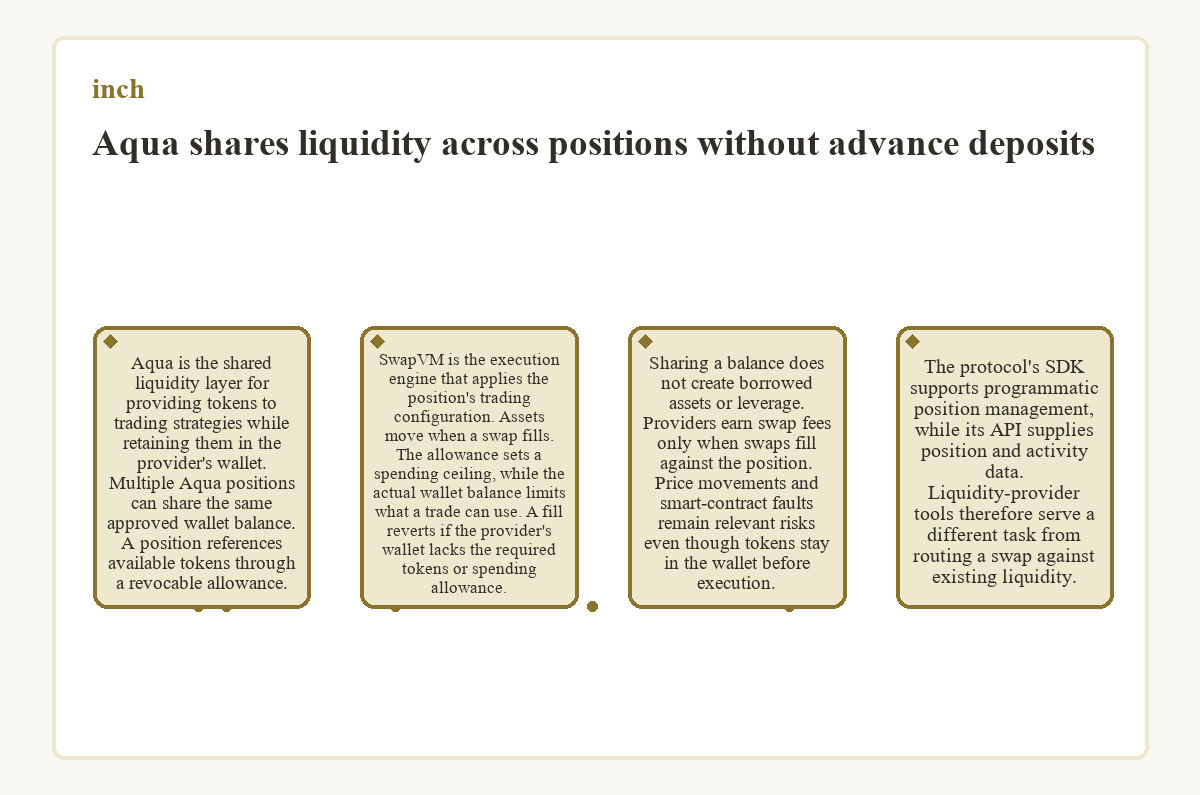
The allowance sets a spending ceiling, while the actual wallet balance limits what a trade can use. A fill reverts if the provider's wallet lacks the required tokens or spending allowance. Sharing a balance does not create borrowed assets or leverage. Providers earn swap fees only when swaps fill against the position. Price movements and smart-contract faults remain relevant risks even though tokens stay in the wallet before execution.
The protocol's SDK supports programmatic position management, while its API supplies position and activity data. Liquidity-provider tools therefore serve a different task from routing a swap against existing liquidity.
Interfaces, developer APIs, and 1INCH governance
The ecosystem combines wallet interfaces for asset management, integration tools for applications, and token-based governance for network decisions.
Wallets and trading interfaces
The browser application connects to supported external wallets, and 1inch Wallet provides a self-custodial mobile entry point. Swap emphasizes streamlined exchanges; Terminal exposes Market and Limit modes, charts, and routing information on supported EVM networks. Access in the United Arab Emirates permits viewing and exiting existing positions, while new swaps and trades are unavailable.
APIs and on-chain data
1inch Business provides application programming interfaces (APIs) for swaps, orderbooks, portfolio information, and blockchain data. Software development kits (SDKs) assist with transaction construction and order handling. The Spot Price Aggregator reports on-chain prices across decentralized liquidity sources. These quoted or observed prices serve a different role from the output that a particular swap can execute.
Governance and staking
1INCH is the ecosystem's governance and utility token, with staking providing weight for governance participation and delegation. In the staking system, st1INCH represents staked tokens, while Unicorn Power measures their voting weight. Delegation directs this weight toward governance or resolver participation under the applicable rules. Staked amount and lock duration affect that weight, while early unstaking can incur a penalty in 1INCH.
Still have questions?
Do I need to hold 1INCH to make an ordinary token swap?
Ordinary wallet-based swaps do not require a balance of 1INCH. The relevant requirements are the assets being exchanged, the selected network, and any spending authorization. EVM aggregation transactions that the wallet submits also need funded network fees. Staking or resolver participation involves separate token requirements from maker access to a swap.
Does disconnecting my wallet remove an ERC-20 approval?
Disconnecting a wallet does not remove its ERC-20 allowances. Those permissions remain on-chain for the particular token and spending contract. Revocation requires a change to that token's allowance for that spender. The change takes effect when the revocation transaction succeeds on-chain; closing the browser or ending a connection does not revoke contract access.
Can two tokens with the same symbol represent different assets?
Different token contracts can use the same symbol. For an ERC-20 asset, the contract address and network identify the token that a swap uses. Its name and ticker are display information. A matching symbol therefore does not establish that a custom-added token represents the asset that you intended to trade.
Why can a watch-only wallet display funds without allowing a swap?
A watch-only wallet contains a public address without the authority needed to sign transactions. It can display balances and activity because those records are public. Spending requires the corresponding signing credentials or a supported connected signer. Adding the public address after reinstalling an application restores visibility without recreating a private key.
What happens to the network fee when an EVM aggregation swap reverts?
An EVM aggregation swap that reverts during on-chain execution still consumes gas. Reverting undoes the swap's state changes; it does not refund fees for computation already performed. This differs from a rejected request that never executes on-chain. A prior approval that completed in a separate transaction also remains in force.
Is an API key enough to authorize spending from my wallet?
An API key authenticates access to application services and does not itself supply a blockchain signature. Swap integrations still need wallet authorization and any required token permissions. A private key provides signing authority.
Which functions remain available in the United Arab Emirates?
The interface permits viewing assets and exiting existing positions in the United Arab Emirates. Order cancellation, position closure, withdrawals, unstaking, reward claims, wallet recovery, and wallet export remain available. New swaps, trades, sending, card purchases, new positions, staking, delegation, and voting are unavailable under that access restriction.
Are smart-contract audits a guarantee that a swap is safe?
A smart-contract audit reviews specific code and does not guarantee that a swap is safe. 1inch has published audits for aggregation, limit-order, and cross-chain contracts. The reviewed version and scope matter. Token behavior, spending permissions, price impact, and wallet security introduce risks that a code review alone cannot eliminate.